
Post 20 – What Are the Most Common Basketball Injuries — and Does Training Actually Prevent Them?
1. The Real Question
“Is basketball inherently injury-prone, or can targeted training prevent injuries?” Parents and athletes frequently ask us this—whether asking how to avoid injury after a teammate gets hurt, or simply inquiring about effective training.
2. The Short Answer
Targeted training can significantly reduce injury risk. Rather than a wide range of unpredictable issues, athletes primarily face three common injuries: ankle sprains, ACL tears, and overuse conditions like patellar tendinopathy. Each requires a specific training intervention, and addressing all three concurrently provides the greatest overall protection.
3. What the Research Shows
The research below is pulled from a 2026 review by Sivasanthosh Sivamani and Anbalagan Pandian, covering five years (2020–2025) of basketball injury-prevention studies — full sources are listed at the end if you want to dig deeper.
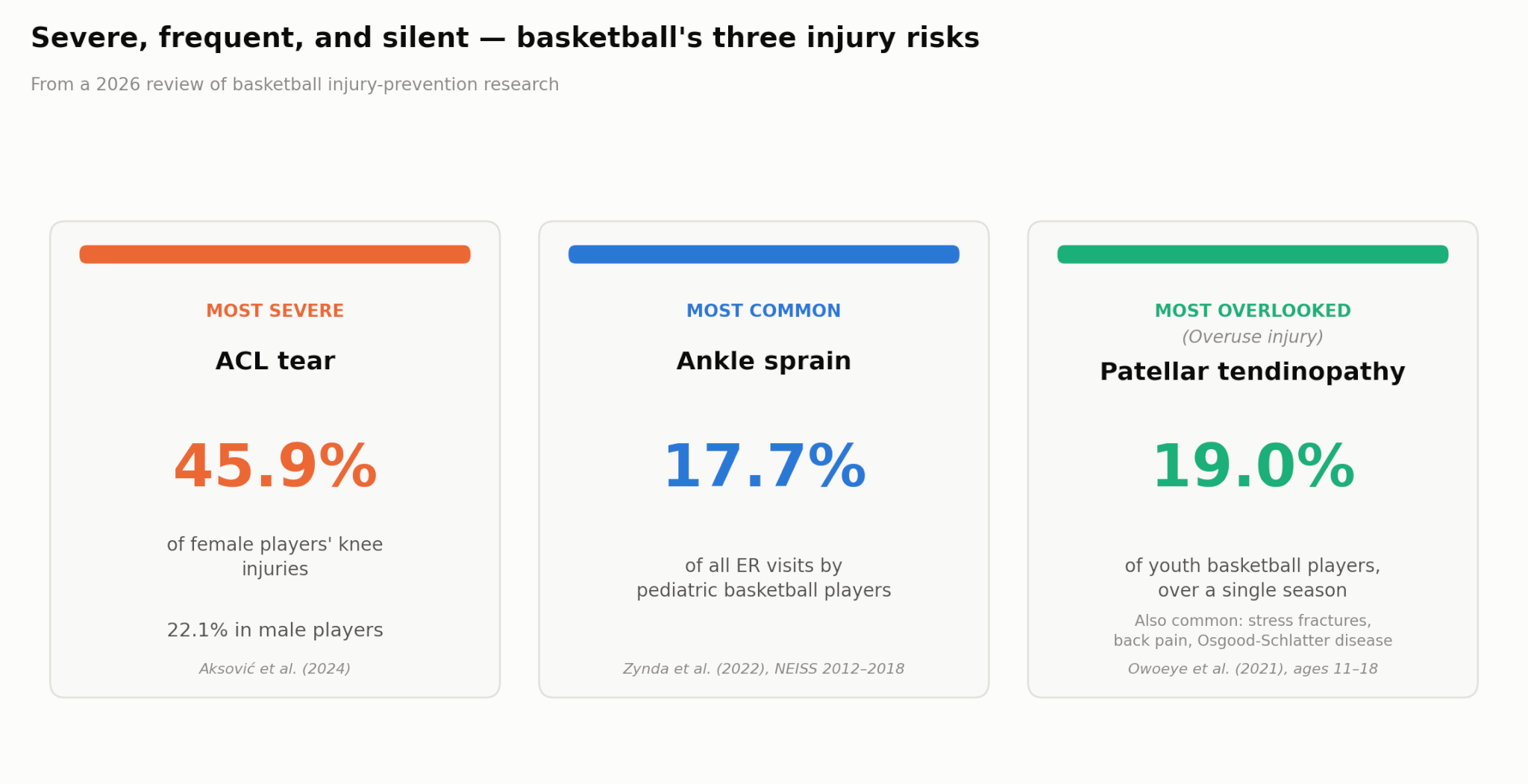
- Each number above is measured differently —ACL tear is a share of knee injuries specifically, ankle sprain is a share of all ER visits, patellar tendinopathy is a share of players tracked over a season.
- ACL tears and patellar tendinopathy barely show up in ER-visit data at all: an ACL tear usually isn’t confirmed until imaging after the ER visit (it gets folded into “knee sprain”), and patellar tendinopathy builds up gradually rather than sending anyone to the ER in the first place
How training impacts each risk:
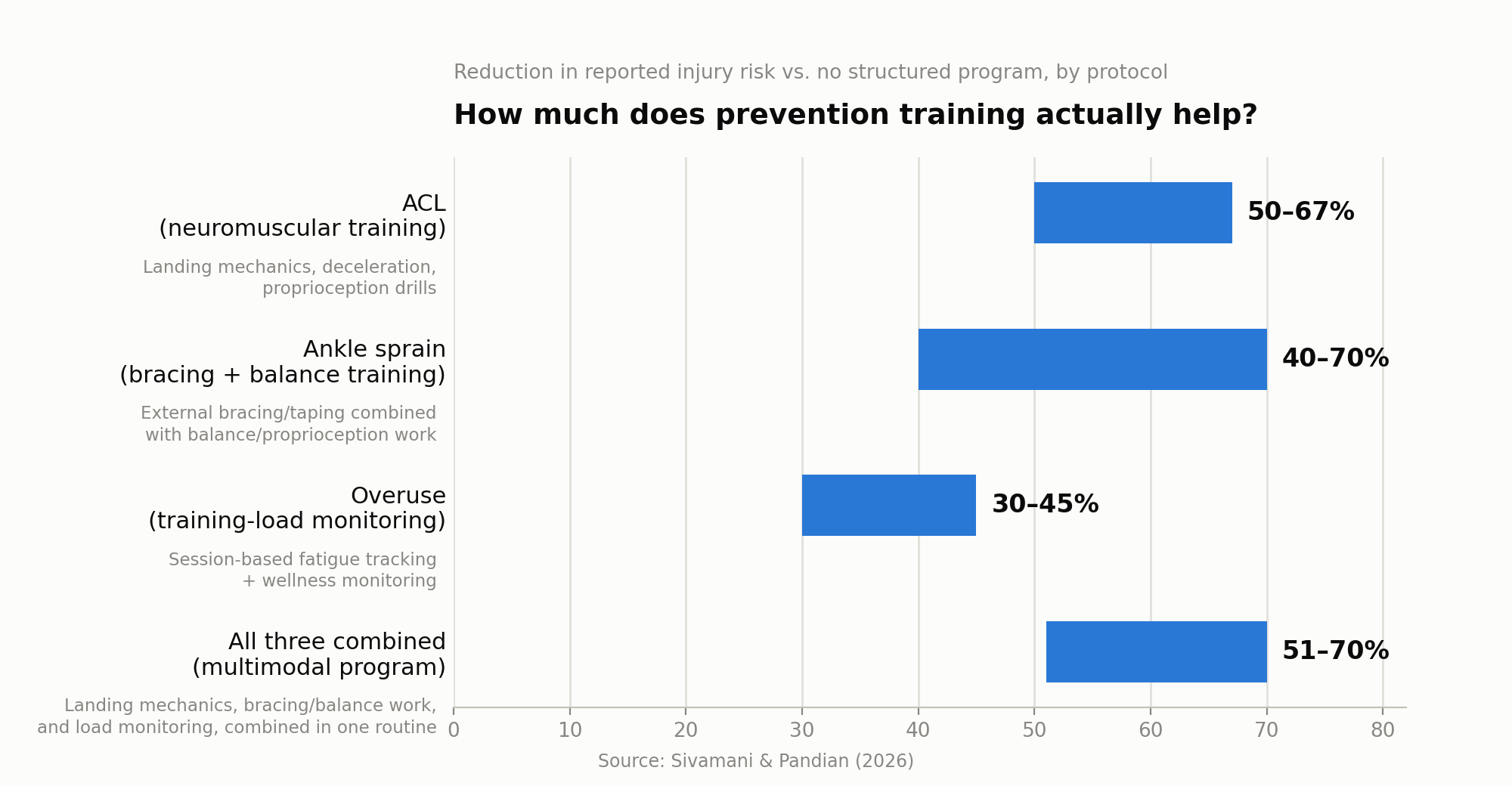
- Neuromuscular training — balance, landing mechanics, and deceleration work — cuts ACL injury risk 50–67%, most effective in adolescent female athletes
- Balance and bracing/taping work cuts ankle sprain recurrence by up to 70%
- For overuse injuries like patellar tendinopathy, load management (tracking fatigue, adjusting volume) matters more than any single exercise
- Combining all three into one program beats doing any one alone — up to 51–70% overall injury reduction
4. What This Looks Like at PPT
The three prevention strategies covered above — neuromuscular training for ACL risk, balance and bracing work for ankle sprains, and load management for overuse — don’t live in our program as a separate “prevention add-on” bolted onto training. They’re already inside what we consider real strength and conditioning: warm-up, rolling, stretching, activation, progressive jumping and plyometrics, loaded jumps, progressive linear/lateral/multi-directional speed work, strength work, core work, and conditioning. Our position is straightforward: good strength and conditioning is good injury prevention. We’re not claiming we can eliminate injury risk — no program can — but the research above is consistent that doing these things, and doing them correctly, lowers the likelihood of injury and can reduce how severe an injury is and how much time it costs an athlete when one does happen.
Balance and ankle stability
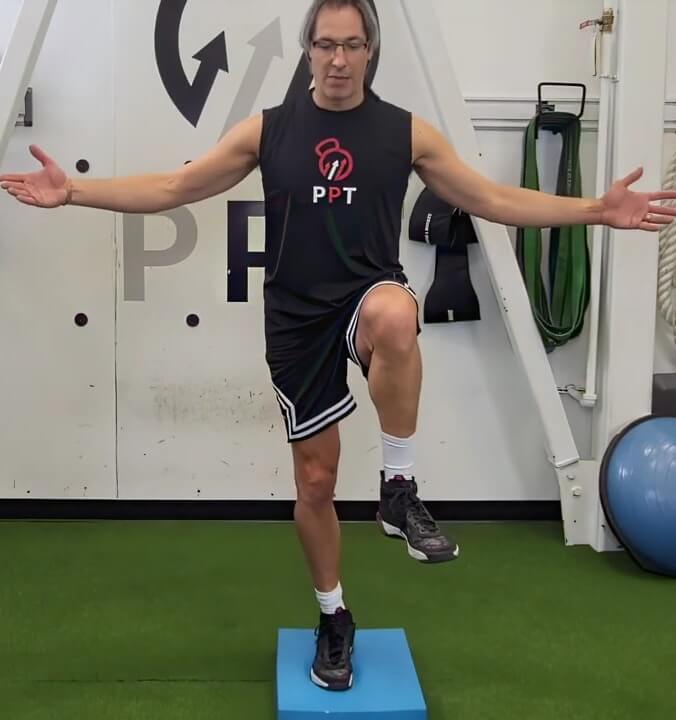
- Single-leg balance during warm-up, aiming for 30 seconds, progressing from stable to unstable surfaces
- Challenges layered in at each level: i.e. eyes closed, perturbations, multitasking, anti-rotation cable core work
- Unilateral squatting and hinging built into every week of strength training, progressing from supported to unsupported (i.e. split squat → rear-foot-elevated split squat → single-leg squat, and a similar progression for single-leg hinging)
- Jump rope worked in as ankle stability and conditioning
Landing mechanics and Deceleration
- Start with snap-downs in early phases and warm-ups: progress from bilateral to unilateral
- Weekly power block includes jumps and plyometrics, progressing the landing from gravity-reduced (box jumps and hops) → eccentric (stick the landing) → semi-elastic (double bounce between jumps) → reactive (continuous hurdle jumps and hops) → advanced plyometric variations
- Direction of jumps and hops progresses as well: start linear, layer in lateral and multi-directional variations over time
- Once an athlete reaches a higher stage of landing/jump training, the lower stages don’t disappear — they become that day’s warm-up
- Speed and acceleration training is a weekly block: one linear day, one lateral/multi-directional day — both start with deceleration before acceleration
- Later phases add change of direction, reactive, competitive, and timed acceleration/deceleration drills
Load management
- Jump volume kept conservative, progressed slowly — never maxed out session to session
- Every session: check in on how the athlete feels, any pain, recent game/practice load — adjust, reduce, or hold jumping that day (sometimes for a week or more) based on what we see
- In-season: avoid training choices that cause unnecessary soreness (i.e. slow eccentric tempos, high volume, training to failure) — a sore, compensating athlete is a higher-risk athlete, not a lower-risk one
5. Bottom Line
- Injury prevention in basketball isn’t a separate program you bolt on — it’s what properly built strength and conditioning already does. Balance and single-leg strength work lower ankle sprain risk, structured landing/deceleration progressions lower ACL risk (especially important for female athletes, who face a meaningfully higher ACL rate), and sensible, conservative load progression helps prevent overuse injuries like patellar tendinopathy.
- These three areas work best together, not in isolation. The research is consistent that combining all three in one integrated routine produces a bigger reduction in overall injury risk than doing any one alone.
- While athletic participation always involves inherent risks and no program can guarantee complete injury avoidance, incorporating evidence-based practices—such as targeted balance and landing progressions, progressive single-leg strength training, and careful monitoring of athlete fatigue and training loads (particularly during the competitive season)—provides an effective, research-backed strategy for lowering overall risk.
6. Sources
- Sivamani, S., & Pandian, A. (2026). Epidemiology and prevention of common injuries in basketball: a review of current strategies. Sport Sciences for Health, 22, 107. https://doi.org/10.1007/s11332-026-01690-0
- Zynda, A. J., Wagner, K. J., Liu, J., Chung, J. S., Miller, S. M., Wilson, P. L., & Ellis, H. B. (2022). Epidemiology of Pediatric Basketball Injuries Presenting to Emergency Departments: Sex- and Age-Based Patterns. The Orthopaedic Journal of Sports Medicine, 10(1). https://doi.org/10.1177/23259671211066503
- Aksović, N., Bubanj, S., Bjelica, B., Kocic, M., Lilic, L., Zelenovic, M., Stankovic, D., Milanovic, F., Pajovic, L., & Sufaru, C. (2024). Sports Injuries in Basketball Players: A Systematic Review. Life, 14(7), 898. https://doi.org/10.3390/life14070898
- Owoeye, O., et al. (2021). The Burden and Risk Factors of Patellar and Achilles Tendinopathy in Youth Basketball: A Cohort Study. International Journal of Environmental Research and Public Health, 18(18), 9480. https://doi.org/10.3390/ijerph18189480