
Post 19 – Does More Plyometric Training Mean a Higher Vertical Jump?
The Myth
Want a higher vertical? Most kids buy into the same myth about vertical jump training: jump more to get a higher vertical and reach your dunking dreams. But almost every new client who walks into PPT already working on their vertical has the same story: they’re doing too much, and their knees already hurt. I’ve seen the same thing with some of the best dunkers in the world — they jumped too much, got hurt, and it wasn’t until they learned proper training volume and technique that their vertical, and their career, really took off.
The Short Answer
No – jumping MORE is NOT always the answer to increasing your vertical jump. Research comparing different volumes of plyometric training found that more jumping doesn’t automatically translate to a higher vertical — past a certain point, extra jumps stop adding results, and low volume actually produced slightly better gains than high volume for the jump that matters most on the court. What actually works is finding the right volume, done with the right technique, not just doing more of it.
What the Research Shows
To find a real answer, we turned to a meta-analysis by Chen and colleagues, published in 2023. Rather than relying on just one study, they combined the results of 38 different studies on plyometric training into a single analysis, covering more than 3,300 adolescent athletes. This kind of study — a meta-analysis — matters because pooling that many studies together gives a much more reliable picture than any single study could on its own.
They split the total jumps done over a full program into three tiers — low, medium, and high jump volumes — and tracked two different kinds of jumps: the squat jump (SJ) and the countermovement jump (CMJ). The squat jump is dip, pause, then jump. The countermovement jump skips the pause — dip down and explode up in one continuous motion, the same thing that typically happens in a real jump shot, rebound, or layup takeoff.
The results weren’t the same for both. For the squat jump, more training tracked with slightly more improvement. But for the countermovement jump — the one that actually resembles what happens on the court — low, medium, and high volume all produced almost the same gains, and low volume even came out slightly ahead of high volume.
Because the countermovement jump is the one that matters for basketball — and it’s the jump PPT uses whenever we test an athlete’s vertical jump — the rest of this post focuses only on those results.

The low-volume group actually came out slightly ahead of the high-volume group for improvements in the vertical jump measured by the CMJ.
Where the Data Has Gaps
One gap worth highlighting: those “under 900 jumps” and “over 1,400 jumps” labels are totals for an entire program, not a per-week or per-session number. The programs Chen pooled ran anywhere from 6 to 10 weeks, mostly twice a week, with sessions in the 20-40 minute range — the study doesn’t give one clean average, it’s a range.
Spread over a typical 8-week, twice-a-week program, low volume works out to roughly 110-115 jumps a week, or about 55-60 jumps a session — these are my own calculations, not the study’s, since Chen’s paper doesn’t break volume down by week or session, only by total program length.
A second gap: this tells you jumps stop paying off past a certain point, but it doesn’t tell you the minimum. The “low” group here still got real gains — we don’t know how much lower you could go and still see them.
We’ll keep an eye on new research and come back to this if either gap gets filled in.
Vertical Jump Training at PPT
In PPT, we don’t start anyone at the upper end of what Chen’s data covers, even in a fully built-up vertical jump training program. My athletes are also doing basketball training and other strength work in the same week — jump volume has to fit around all of that, not exist on its own.
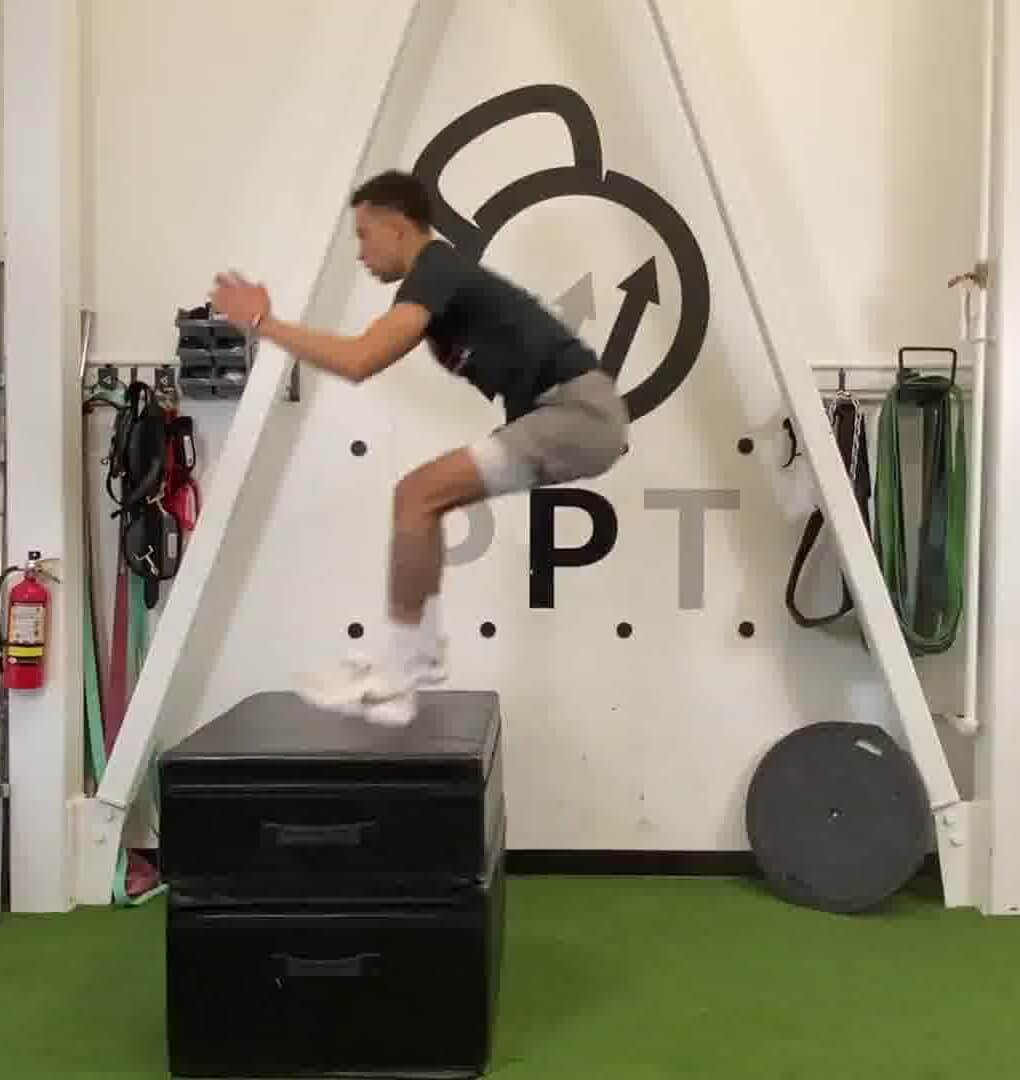
I’d rather start low and build. Three sets of five to eight jumps — 15 to 24 jumps a session — is where I put most athletes to begin. From there I’m watching how they respond: how they feel the next day, whether their jumps are actually getting higher, whether landing mechanics hold up as reps add up. That tells me more than any number from a study.
If an athlete handles that well and there’s a real reason to push further, we can move toward the higher end of what Chen’s data covers. But that only happens with the same monitoring the whole way — it’s not a number you set and forget.
You don’t need to chase that upper limit at all. The point isn’t that you should reach it — it’s that one exists, and past it, the returns start shrinking.
For a broader look at building a bigger vertical, see our guide on how to increase your vertical jump.
Bottom Line
- More jumps past a certain point don’t buy a higher vertical jump — Chen’s data shows low, medium, and high volume all landed in roughly the same range for the countermovement jump, the one that matters most on the court.
- Start low (15-24 jumps a session) and let the athlete’s response — not a number from a study — tell you whether to add more.
- If the volume goes up, keep monitoring CMJ improvements. The extra jumps aren’t dangerous, they just stop doing much for jump height once you’re past the low end.
Sources
Chen, L., Huang, Z., Xie, L., He, J., Ji, H., Huang, W., Li, D., Zhou, Y., & Sun, J. (2023). Maximizing plyometric training for adolescents: a meta-analysis of ground contact frequency and overall intervention time on jumping ability. Scientific Reports, 13. https://www.nature.com/articles/s41598-023-48274-3