
Post 21 – My Teen Plays Basketball Every Day: Do They Still Need Strength Training?
1. The Real Question
“My teen plays basketball every day. Practices, games, skill sessions, maybe pickup on the weekend. They’re jumping and sprinting all the time. Do they really need strength training on top of that, especially during the season?”
I hear this from parents all the time, usually right as the season starts. It’s a fair question. Basketball is physically demanding, so it’s easy to assume all that jumping and running keeps a young player’s legs strong and explosive.
But being active isn’t the same as getting stronger. So the real question is whether basketball alone is enough to maintain, or even improve, a teen’s strength and vertical jump during the season, or whether adding strength training makes a real difference.
Researchers tested exactly that, with teen basketball players in the middle of their season.
2. The Short Answer
In this study, basketball alone wasn’t enough.
Over a 10-week season, 14–15-year-old players who only did their regular practices and games saw their jump scores drop or stall. Teammates who did the same basketball schedule plus two strength-training sessions a week improved their jumps. Same sport, same season, same practices. The only difference was the strength training.
3. What the Research Shows
The main study: teen basketball players, in season (Santos & Janeira, 2012)
Researchers followed 25 male basketball players, aged 14–15, through 10 weeks of their competitive season. All of them kept the same basketball schedule: three 90-minute practices and one game per week.
They were split into two groups:
- Basketball only (10 players): regular practices and games, nothing else.
- Basketball + strength training (15 players): the same practices and games, plus two strength sessions per week.
The strength program wasn’t extreme. It was mostly machine-based: leg press, leg extension, leg curl, lat pulldown, decline press and pullover. Players did 2–3 sets of 10–12 reps, and the load went up about 5% as they got stronger.
Players were tested before and after the 10 weeks on several jumps and a medicine ball throw.
What happened
After 10 weeks, the two groups went in opposite directions on the jump tests.
| Test | Basketball + strength | Basketball only |
|---|---|---|
| Countermovement jump (standard vertical jump) | +10% (+3.4 cm, about 1.3 in) | −8% (−2.4 cm, about 0.9 in) |
| Squat jump (jump from a paused squat, no dip) | +12.5% | −9% |
| Abalakov jump (vertical jump with arm swing) | +10% | −5% |
| Depth jump (drop off a box, then jump) | +9.5% | −1% (basically no change) |
| Medicine ball throw | +7.6% | +5.5% |
On the standard vertical jump, that’s a gap of about 6 cm, or 2.3 in (+3.4 cm gained vs. −2.4 cm lost = 5.8 cm), between teammates following the same basketball schedule.
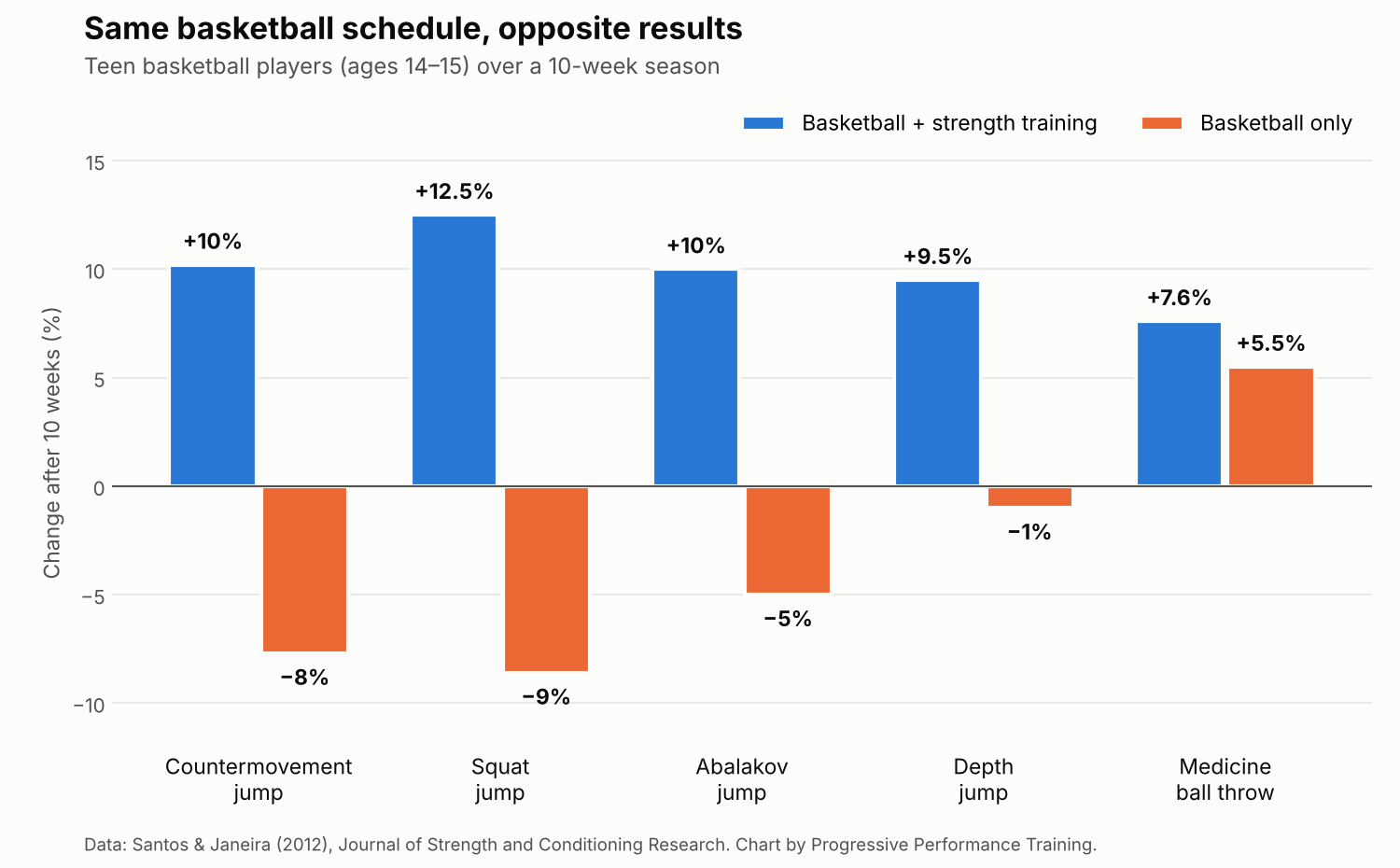
The basketball-only group did improve on the medicine ball throw, so playing wasn’t doing nothing. But on every jump test, the strength group came out ahead, and by the end the two groups were significantly different on every measure.
The supporting study: teen soccer players (Christou et al., 2006)
A second study used the same comparison in a different court/field sport. Soccer involves running, cutting and jumping, like basketball. Researchers followed boys aged 12–15 for 16 weeks and split them into three groups:
- Soccer only (9 players): five 90-minute practices a week, plus a game.
- Soccer + strength training (9 players): the same soccer schedule, plus two strength sessions a week. These used weights and machines, at 2–3 sets of 8–15 reps with moderate-to-moderately-heavy loads (55–80% of max).
- Non-athletes (8 boys): same age, no sport, no training. This group shows how much change comes from growing alone.
| Measure | Soccer + strength | Soccer only | Non-athletes (growth only) |
|---|---|---|---|
| Leg press strength | +59% | +34% | +17% |
| Countermovement jump | +25% | +6%* | +10%* |
| Squat jump | +31% | +10%* | — |
| 30 m sprint | 2.5% faster | no change | — |
*Not a statistically significant change.
The soccer-only group got stronger too, more than growth alone would explain. But the players who added strength training gained far more leg strength. Theirs were also the only jump and sprint improvements that held up statistically. No injuries were reported from the strength training.
The gaps: what these studies don’t tell us
No study is perfect, and these two have real limits:
- Small groups. 25 players in the basketball study, and 26 boys across three groups in the soccer study. The results are clear, but small studies can overstate effects.
- Boys only. Neither study included girls. There’s no clear reason to expect a different direction, but these studies didn’t test it.
- Starting points weren’t identical. In the basketball study, the strength group’s starting jump averages were slightly higher. The researchers report the groups were statistically similar at the start, and they went in opposite directions anyway.
- Mostly machines. Both programs relied heavily on machines. They don’t show what free weights, or strength training combined with jump training, would do.
- Not every measure improved. In the soccer study, the 10 m sprint didn’t change in any group. Both soccer groups improved on the agility test by similar amounts, and the strength group lost about 8% flexibility.
- Muscle size wasn’t compared directly. The soccer study’s strength group had bigger thighs and calves than the non-athletes, but wasn’t compared with the soccer-only group on this.
- Older research. These studies are from 2012 and 2006. The findings line up with newer research on youth strength training, but neither study is new.
4. What This Looks Like at PPT
We train our athletes year-round, and we recommend it. In my experience, that’s how serious athletes train at every level, from prep to college to the pros. The season isn’t a break from strength training. These studies show that skipping strength training during the season can cost you.
In season we still train hard, but we change how we train:
- No training to failure. Sets end with reps left in the tank.
- No slow or exaggerated eccentrics. These can cause more soreness, which players can’t afford during games.
- Lower volume. Fewer total sets, so athletes recover in time for practice and games.
- Careful jump volume. Practices and games already involve a lot of jumping, so we add jump work gradually.
- Flexibility work. Every session includes a warm-up with rolling, stretching and activation, which may help offset the drop in flexibility seen in the soccer study.
- Session-by-session adjustments. We adjust based on how the athlete feels, any pain, and their recent game and practice schedule.

The goal is simple: keep building strength and power through the season without leaving athletes sore or worn down when it’s time to play.
5. The Bottom Line
- Playing basketball alone isn’t enough. In this study, teen players on a normal practice and game schedule saw their jump scores drop or stall over the season. Teammates who added strength training improved.
- You don’t need much to make a difference. Two strength sessions a week, on top of a full basketball schedule, was enough.
- Don’t stop when the season starts. Keep strength training year-round, and adjust it in season so it builds players up without wearing them down.
6. Sources
Santos, E. J. A. M., & Janeira, M. A. A. S. (2012). The effects of resistance training on explosive strength indicators in adolescent basketball players. Journal of Strength and Conditioning Research, 26(10), 2641–2647. Free full text (University of Porto)
Christou, M., Smilios, I., Sotiropoulos, K., Volaklis, K., Pilianidis, T., & Tokmakidis, S. P. (2006). Effects of resistance training on the physical capacities of adolescent soccer players. Journal of Strength and Conditioning Research, 20(4), 783–791. https://doi.org/10.1519/R-17254.1